
Director of IUIAS
I was just appointed Director of Indiana University’s Institute for Advanced Study (IUIAS). Here is my letter to our community:

A Letter from the Director
Throughout my career, some of the most meaningful questions I have pursued have taken me beyond my own discipline. Working with people who brought new expertise and different ways of understanding the world changed both the questions we asked and how we answered them. Those experiences taught me that every discipline illuminates something others cannot fully see.
The delight I find in learning from others is what drew me to Indiana University’s Institute for Advanced Study (IUIAS).
Universities bring together people who ask different kinds of questions. Some seek to better understand the natural world. Others ask what it means to be human, how societies flourish, or how we can shape the future. IUIAS is where different ways of understanding the world come together.
As I begin serving as Director, my goal is to build on the Institute's remarkable strengths. I want IUIAS to be a place where scholars feel welcome to ask ambitious questions, learn from one another, and discover collaborators they might never have met otherwise. I hope more people across campus come to see IUIAS as a place where they belong.
If you find joy in learning from people whose expertise differs from your own, I hope you will join us—attend an event, participate in a working group, visit the Institute, or simply come by and start a conversation.
I look forward to learning from you.
Shahzeen Z. Attari
Director
Indiana University Institute for Advanced Study
📢 New paper: Naturalness catalyzes public support for carbon dioxide removal and low-carbon energy technologies
Abstract: Carbon dioxide removal and low-carbon energy technologies offer promising methods to reduce greenhouse gas emissions, yet widespread deployment depends on public support. Two studies in the United States examined how naturalness shapes public support for six carbon dioxide removal and four low-carbon energy technologies. To the degree that participants in Study 1 perceived technologies as more natural, they supported them more, judging them as less risky and frightening, and more beneficial. In an experimental manipulation in Study 2, participants who considered technologies analogized as natural supported them more, perceiving them as less risky, more beneficial, and more positive than when the same technologies were analogized as artificial. The effect of naturalness on support was especially large among those more averse to tampering with nature. Individual-level political ideology did not moderate the effect of naturalness. These findings advance research on public support for sustainability technology, informing design, investment, and communications.
https://www.nature.com/articles/s43247-026-03829-w
Huge congratulations to Dr. Sarah Gonzalez-Coffin for spearheading this work! 🌟
Chantarelles
Gorgeous bright chanterelle mushrooms paved my hike at Brown County this weekend. These beauties are edible and need to be hand harvested in the forest. Happy summer.

Kasie presents her work

Kasie Chappell will be presenting her research at International Textile and Apparel Conference in Jacksonville Florida in November 2026. ⭐
New grant: Walking as Inquiry
I received a 2026 Walking as Inquiry Research Grant from Indiana University. The competitive grant program supports faculty projects that investigate walking as a research methodology and object of study, with a focus on place, embodiment, mobility, and the production of new humanities scholarship.
My project explores how walking through the cities my father once called home shapes my understanding of grief, memory, beauty, and joy.
👣
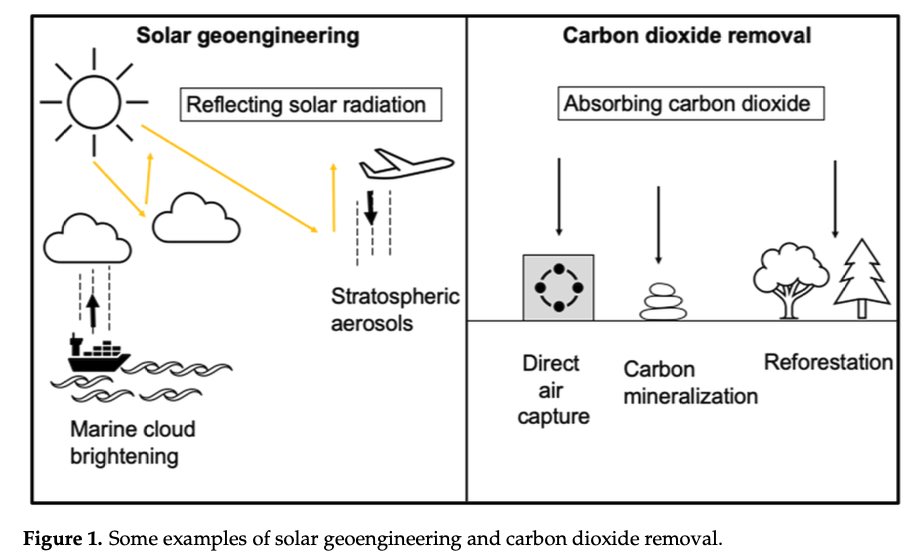
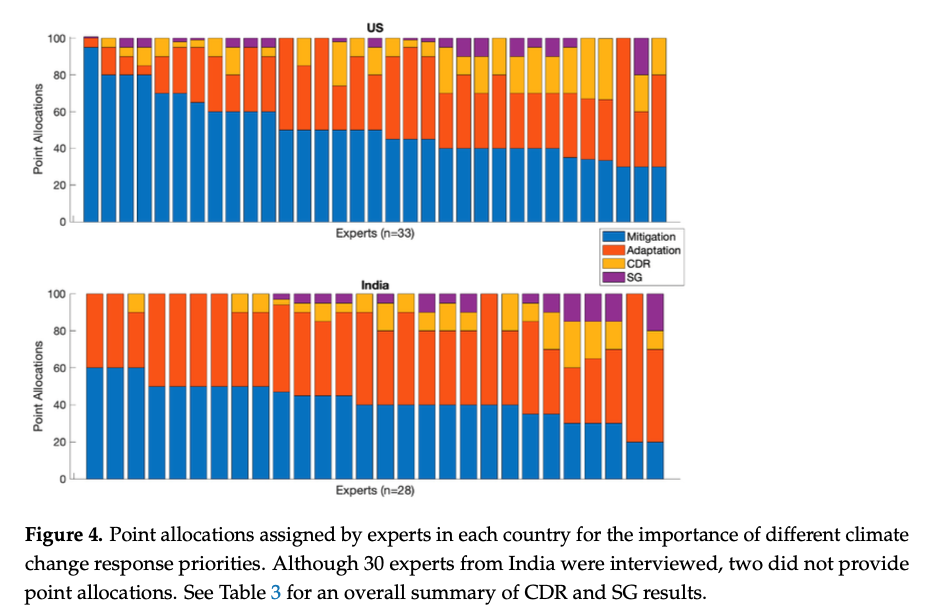
📢 New paper: Expert Perceptions of the Viability and Importance of Solar Geoengineering and Carbon Dioxide Removal in Addressing Climate Change: A Snapshot from India and the United States
Given the enormous span of potential strategies to address climate change, it is difficult to build consensus on what to prioritize. In 2021, we conducted 63 semi-structured interviews with climate change experts in the U.S. (N = 33) and India (N = 30). Experts indicated how they would address climate change through mitigation, adaptation, carbon dioxide removal (CDR), and solar geoengineering (SG). Our experts studied climate change from a variety of disciplines and were not necessarily subject matter experts in CDR or SG. Most experts stated that while more research is needed on CDR and SG, there is low appeal to deploying them in responding to climate change. Across our entire sample, we find that 44% of experts supported deploying CDR compared to 3% for SG. We also find that 17% of experts opposed the deployment of CDR, while twice as many (35%) opposed deploying SG. While there is far more support for traditional measures like mitigation and adaptation, most experts were hesitant to support technologies like CDR and SG to limit warming to 1.5 ◦C or 2 ◦C to prevent dangerous climate impacts, with statements tending toward a precautionary principle. Deep interdisciplinary engagement by climate change experts on CDR and SG is essential to understanding these technologies’ potential roles in addressing climate change and the perceptions of risk of these technologies held by experts who work on other areas of the climate problem. We highlight the potential for follow-up studies on broader expert opinions of CDR and SG, as well as evaluating whether perceptions and opinions are lagging behind fast-changing developments in the field.
Congrats to Kasie Chappell on her fellowships

Kasie Chappell, who is working on her masters thesis, was just awarded the Fred Fisher MSES Fellowship and the O'Neill Environmental Science Fellowship for her work.
Her work focuses on integrated systems modeling of sustainable fashion consumption. She will be exam how structural, informational, and cognitive factors interact to shape behavior and environmental outcomes using dynamical systems and meta-analysis.
Way to go, Kasie!
Congrats to Wenrui Qu on her new research award

Wenrui was awarded a Sustainability Research Development Grant by Environment, Society and Sustainability Institute (ESSI). This work is a collaboration with David Konisky and our lab.
Her work will be on interventions to address misinformation that impedes large scale renewable energy adoption: Investigations from Indiana and the U.S.
⭐ Huge congratulations. ⭐
Ty Trapp and Katie Goodman presents at Sustainability Symposium at IUB
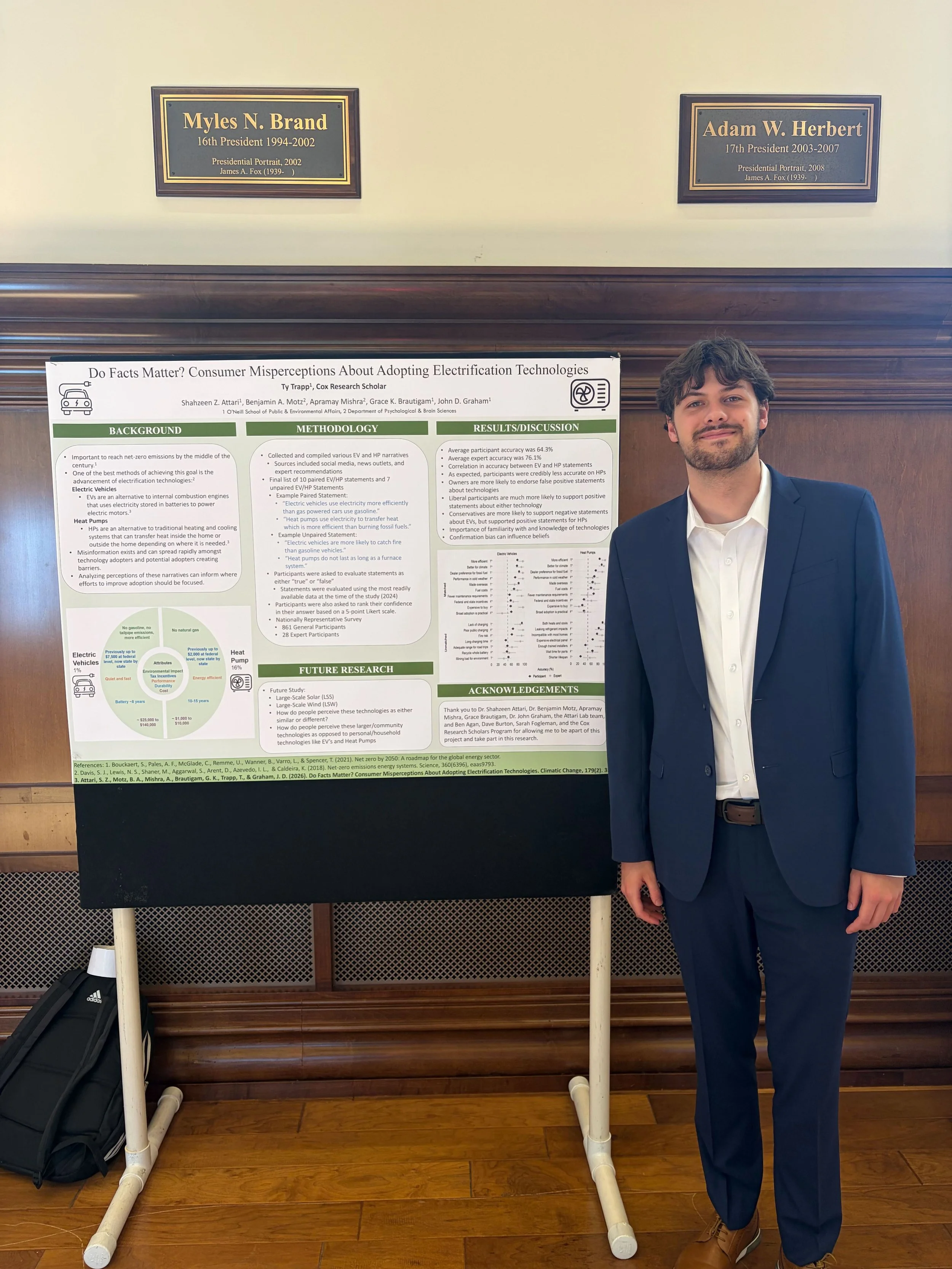
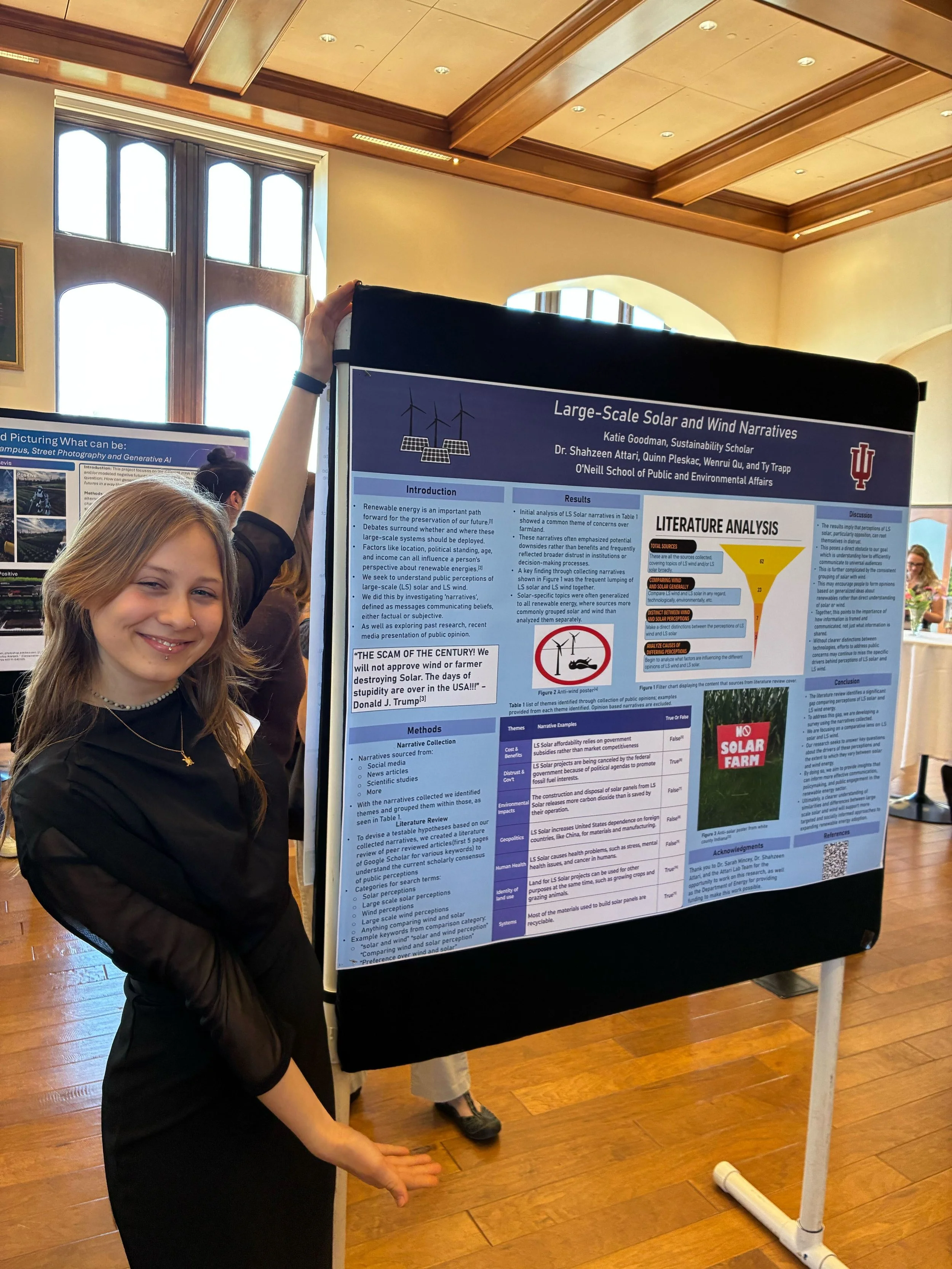
Ty will be presenting a poster of our work on electric vehicles and heat pumps at the inaugural IUB Undergraduate Symposium for Creative Activity and Research.
The event will take place on Thursday, April 23, at the IMU. He will be presenting his poster from 2:00-4:00 pm. See you there. Undergraduate Symposium
Katie will be presenting a poster of our ongoing work on narratives for large scale wind and large scale solar at the Sustainability Symposium, 3:00 pm – 5:00 pm at Franklin Hall.
✨ Congratulations, Ty and Katie ! ✨
Connecting on climate: Perceived similarity to a climate victim increases the likelihood of donation
🌟 Warm congrats to Dr. Deidra Miniard on publishing another paper from her dissertation work. 🌟
Abstract: Social distance refers to the perceived psychological distance between the self and another person on dimensions such as race and class, and influences climate change attitudes and behavior. In two online experiments, we investigated the effect of manipulating social distance on donation to a climate organization, how soon participants want action on climate change, and psychological distance of climate change. Study 1 (N = 1150) asked participants to read a vignette which manipulated the race and income class of a climate victim, and Study 2 (N = 1248) changed only the race of the climate victim. Participants who reported feeling similar to the hypothetical climate victim were more likely to donate to a climate organization (Study 2; 46.6% who perceive themselves to be similar versus 34.0% who perceive themselves to be different). We also find that Republican participants who perceive the climate victim as similar want action sooner than Republican participants who view the victim as different. Finally, participants who perceive the victim as similar to themselves also view climate change as less psychologically distant. However, since perceived similarity was not randomly assigned, these relationships should not be interpreted as causal. Our findings suggest that feelings of similarity to climate victims may relate to climate attitudes and behaviors, though this connection requires further investigation.
Do Facts Matter? Consumer Misperceptions about Adopting Electrification Technologies
Paper: Climatic Change
Press release: O’Neill
Authors: Shahzeen Z. Attari, Benjamin A. Motz, Apramay Mishra, Grace K. Brautigam, Ty Trapp, and John D. Graham
Abstract: Consumer adoption of electrification technologies such as electric vehicles (EVs) and heat pumps (HPs) is critical for mitigating climate change. While previous research has focused on demographic factors, incentives, and technology attributes, we do not yet understand how consumers' ability to discern fact from fiction about these technologies relates to their adoption interest. In a preregistered study, we conducted an online national U.S. survey (n = 861) to investigate relationships between adoption interests and participants’ ability to discern true and false narrative statements about EVs and HPs. Our results show distinct consumer segments and reasons for technology adoption. We also find that adoption interest is not significantly associated with participants’ ability to discriminate accurate information about the technologies. Surprisingly, technology owners are less accurate than non-owners, being more likely to endorse false positive narrative statements and less likely to endorse correct negative narrative statements, regardless of technology. The disconnect between adoption and accuracy suggests that efforts to promote these technologies should focus beyond information provision to also address consumers’ biases. Politically liberal participants were biased toward positive statements, while politically conservative participants were biased toward negative statements about these technologies, again indicating confirmation bias. This bias is far stronger for EVs than HPs, given that HPs are broadly less familiar and less politically polarizing. Our work shows how participants systematically succumb to confirmation bias when navigating information which can dramatically shape adoption interest.
🙏🏽 Our work is supported by the Paul H. O’Neill professorship awarded to S.Z.A. at the O’Neill School of Public and Environmental Affairs and the Cox Research Scholarship program at Indiana University Bloomington for funding T.T. We also thank Diksha Singh and Lucas Giese for research assistance. The authors would like to thank each of our expert, novice, and pretesting participants for completing our survey.